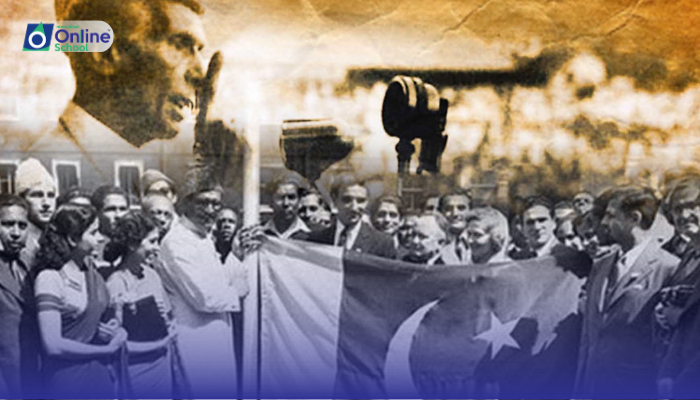
Landmark Events: 1857 to the Creation of Pakistan
i. British Ascendancy
In the year 1857, eight hundred year long Muslim rule over India came to an end. In 1858 India was given under the direct control of the British Crown.
ii. The Aligarh Movement
Sir Sayyad found the solution of the Muslim problem in the British education system and in making friendship with the British rulers. In 1875 he founded the Aligarh School and established many other educational and research institutions and also brought out a magazine Tehzeeb-ul-Ikhlaq". Urdu-Hindi controversy started by the Hindus in 1867 gave Sir Sayyad's ideas a new direction. In Hindu antagonism towards Urdu he foresaw a parting of the ways between the two communities.
iii. Extremist Hindu Movements
The anti-Muslim movement Arya Samaj flourished in the last two decades of the nineteenth century. The movement aimed at reconverting the Muslims to Hinduism. Bankim Chandra Chatterji wrote a novel "Anand Matth" which provoked Muslims' religious sentiments. Anti-Muslim epic Bande Mataram was a part of this novel.
Pakistan is the outcome of the sustained Muslim struggle spread over a period of ninety years. In order to understand the real nature of this struggle we must be aware of the significant events that took place during this period.
iv. The Partition of Bengal
In the year 1905 Lord Curzon partitioned Bengal into two parts i.e. East Bengal and West Bengal. This step was taken mainly due to administrative reasons. Since this partition benefited the Muslims, the Hindus and the Indian National Congress opposed it vehemently. The Muslims started to feel that they should have a political platform of their own to voice their aspirations and take their demands up with the government.
v. The Simla Deputation and Demand for Separate Electorate
Thirty-five top ranking Muslim leaders called on the then Viceroy Lord Minto at Simla on Oct. I, 1906 and presented the Muslims' demand before him. Separate electorate was the most significant of the Muslim demands. Viceroy's attitude was sympathetic and encouraging.
vi. Establishment of the Muslim League
Encouraged by the success of the Simla Deputation the Muslims decided to establish "The All India Muslim League". The decision was taken at the session of the "Muhammadan Educational Conference" held at Dacca in December 1906. Sole purpose of the establishment of the Muslim League was to take up the Muslim demands with the government through constitutional means.
vii. Proposals For the Solution of the Constitutional Problems
Constitutional problems of India were of very complex nature. Numerous efforts were made to work out a conciliatory formula which would satisfy the British, the Hindus and the Muslims at the same time. Given here is a brief overview of the proposals made by different groups in this regard:
i. Minto-Morley Reforms or the Government of India Act 1909.
ii. The Lucknow Pact 1916 (jointly agreed Congress-League constitutional proposals).
iii. Montague-Chelmsford Reforms or the Government of India Act 1919.
iv. The Delhi-Muslim Proposals 1927 (another conciliatory effort made by the Quaid-e-Azam).
v. The Simon Commission 1928.
vi. The Nehru Report 1928 (anti-Muslim Congress stance).
vii. The All Parties Muslim Conference (1928-1929).
viii. The Quaid-e-Azam's Fourteen Points 1929, (minimum Muslim constitutional demands; another effort by the Quaid-e-Azam to reach a mutually agreed constitutional accord).
ix. The Round Table Conference, London, 1930 to 1932, (an effort made by the British government to hit at a commonly agreed constitutional formula).
x. Communal Award: Declaration of the British Government regarding the future constitution of India after the failure of Indian representatives to reach an agreed formula.
xi. New constitutional arrangement; the Government of India Act 1935.
xii. Arrival and failure of the Cripps Mission (1942).
xiii. The Cabinet Mission Plan (1946); (a sincere British effort towards the solution of the constitutional problem).
xiv. British Prime Minister's declaration of February 20, 1947. (Announcement of the British decision to quit India till June 1948).
Mountbatten's arrival and Third June 1947 Plan (final proclamation of the Partition Plan).
Indian Independence Act July 1947; (approved by the British Parliament).
viii. Evolution of the Muslim League's Constitutional Struggle
i. Established; Dacca 1906.
ii. Establishment of the London branch of the Muslim League; 1908.
iii. Amendment of the objectives; demand of self-government under the British umbrella, 1913.
iv. The Quaid-e-Azam joins Muslim League (1913).
v. Congress-League reconciliation (Lucknow Pact 1916).
vi. The Quaid-e-Azam quits the Home Rule League and the Congress (1920).
vii. Delhi Proposals (1927); another effort of reconciliation by the Quaid-e-Azam.
viii. Adoption of the resolution embodying Fourteen Point formula rendered by the Quaid-e-Azam (1929).
ix. Allahabad Address (1930); Allama Muhammad Iqbal's proposal for the Muslim right of self-determination.
x. Steps taken by the Quaid-e-Azam for the re-organization of the Muslim League (1935).
xi. Muslim League's poor performance in the general elections (1936-37).
xii. Mass movement against the Congress, organized by the Muslim League. The Muslim League takes off as a popular movement (1937-1939).
xiii. The Lahore Resolution adopted (1940).
xiv. The Muslim League merited with exemplary success in the general elections (1945-46).
xv. "Direct Action Day" observed by the Muslims throughout India, the Muslim League demonstrates its street power (August 16, 1946).
ix. Other Important Events
i. 1911: Annulment of the Partition of Bengal.
ii. 1920: Aligarh College rose to the status of a University under Aligarh University Act.
iii. 1919: Beginning of the Khilafat Movement to avert danger of dismemberment of the Turkish Empire at the hands of the British and their Allies, after their victory in the Second World War. During this period Hindus-Muslim unity reached its apex.
iv. 1924: Abolition of the institution of Khilafat by Mustapha Kamal Ata Turk; end of the Khilafat Movement.
v. 1923-24: Civil Disobedience Movement, launched by Gandhiji to support the Khilafat cause, was called off and with this Hindu Muslim riots took over the entire Indian sub-continent.
vi. 1933: Chaudhary Rehmat Ali proposed the name of 'Pakistan'; and established, "Pakistan National Movement".
vii. 1934: Extremely disappointed at the despondency of the Muslims the Quaid-e-Azamwho had decided to settle permanently in London in 1931, changed his decision and came back to India in 1934, on the request of the Muslim leaders especially Allama Muhammad Iqbal.
vii. 1937: The Congress and the allied parties were able to form governments in seven out of the eleven Indian provinces; these governments set a record of bad governance and partiality against the Muslims.
ix. 1937: The Punjab Muslim Students Federation adopted the demand of a separate Muslim homeland as its objective and made it a part of its constitution. This was done on Allama Iqbal's advice.
x. October 1939: The Congress ministries resigned office as a result of the Congress's disagreement with the British government, the later had demanded Indian support in her War enterprise.
xi. December 22; 1939: To mark the end of the oppressive Congress rule. The Muslim League observed 'Deliverance Day' on Quaid-e-Azam call.
xii. June 1945: Viceroy Lord Wavell and the Indian leaders failed to reach an agreement on constitutional issues in the Simla Conference.
xiii. October 1946: The Muslim League joined the interim government as a political move and was able to sabotage it.
xiv. August 11, 1947: Opening session of the first Constituent Assembly of Pakistan was held at Karachi.
xv. August 14, 1947: Lord Mountbatten, the last viceroy of the British India transferred power to the Governor General of Pakistan. He came to Karachi to deliver his last address. Beginning of a new era in the history of the Indian Muslims.
In the following pages we shall study, in a bit detail, certain landmark events in the history of our freedom struggle. Viewed in the light of the brief background given in the preceding lines, it will be easier for us to understand these events in their true perspective.
